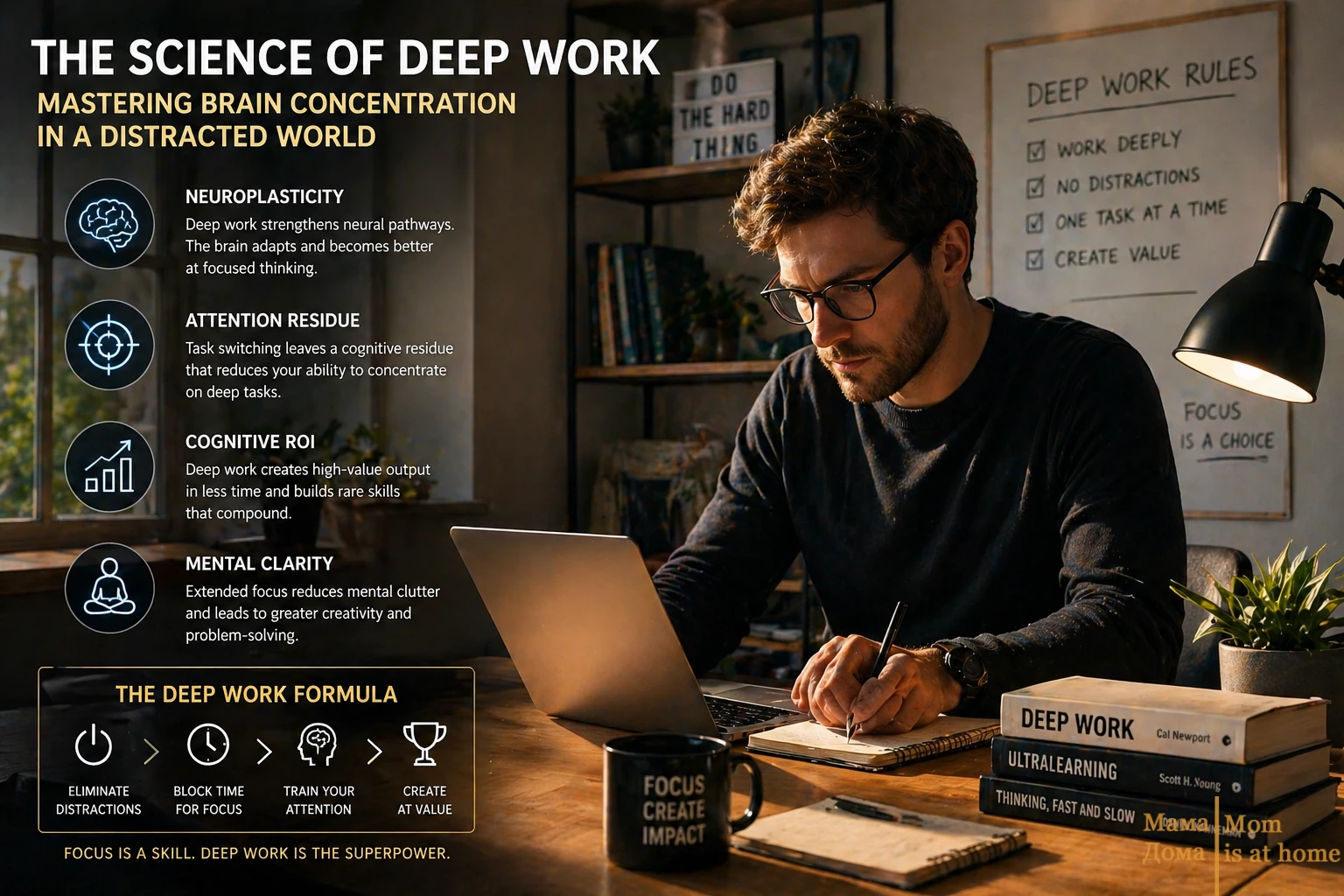
The Neurobiology of Focus: Wiring Your Brain for Success
To understand the benefits of deep work, we must first look at what happens beneath the skull. From a scientific perspective, deep concentration triggers a process known as myelination. Myelin is a fatty tissue that wraps around nerve fibers, acting as an insulator for neural pathways. When we focus intensely on a specific skill or problem, we trigger the growth of myelin around the relevant neurons, allowing electrical impulses to fire more rapidly and efficiently. This is why deep work is the fastest route to skill acquisition. Think of it as upgrading your brain’s internal wiring from a dial-up connection to high-speed fiber optics.
However, the modern digital environment is designed to disrupt this process through a phenomenon called “attention residue.” Research by Sophie Leroy, a business professor at the University of Minnesota, suggests that when you switch from Task A to Task B, your attention doesn’t immediately follow. A portion of your cognitive resources remains stuck on the previous task. Every time you check a quick Slack message or a “brief” email notification, you are essentially poisoning your concentration for the next 20 minutes. For digital entrepreneurs working at a computer, this constant fragmentation prevents the brain from ever reaching the “flow state”—that elusive zone where time disappears and creativity peaks.
The challenge is further complicated by the brain’s limbic system, which is naturally drawn to the novelty of social media pings and news alerts. Evolutionarily, we are wired to pay attention to new stimuli because they might represent a threat or an opportunity. In the 21st century, this ancient hardware is being hijacked by “variable reward” algorithms used by tech giants. To counter this, one must consciously leverage the prefrontal cortex—the seat of willpower and logic—to build a “fortress of focus.” By eliminating context switching, you allow your brain to reach the depths of concentration where original ideas and complex problem-solving occur.
Maximizing the Benefits of Deep Work for Entrepreneurs
For those in the digital economy, the benefits of deep work translate directly into competitive advantages. First, there is the “Quality-Speed Trade-off” which deep work effectively solves. When you operate in a deep state, you are not just working harder; you are working “denser.” A four-hour block of undisturbed deep work can often produce more meaningful results than an entire week of frantic multitasking. This is because the brain can hold more complex variables in its working memory simultaneously when it isn’t being interrupted, leading to more elegant solutions in coding, strategy, or design.
Furthermore, this practice significantly reduces mental fatigue. While it sounds counterintuitive, focusing on one difficult task is actually less taxing for the brain than the constant “stop-and-start” energy drain of shallow work. Every time you switch tasks, your brain has to load new “software” and clear the old data, which consumes massive amounts of glucose and oxygen. By embracing depth, you preserve your cognitive energy for the tasks that actually move the needle for your business.
Finally, there is the psychological benefit. Deep work is intrinsically satisfying. In a world of “performative busyness,” completing a difficult, high-value task provides a sense of accomplishment that checking 50 emails can never match. This boost in professional self-esteem is vital for entrepreneurs who face the daily stresses of building a company from scratch. It shifts the focus from “doing more” to “producing more value,” which is the true hallmark of successful digital leadership.
Top 3 Tips for Digital Entrepreneurs
- Embrace Boredom: Train your brain to tolerate a lack of stimuli. If you reach for your phone the moment you feel a second of boredom (like standing in line or waiting for a page to load), you are teaching your brain to reject deep focus. Practice “waiting” without digital distraction to strengthen your concentration muscles. This builds the neurological stamina required for long-form work sessions.
- The “Shutdown” Ritual: Deep work requires deep rest. Create a strict ritual to end your workday—physically closing your laptop, reviewing your tasks for tomorrow, and saying a specific phrase like “work complete.” This allows your subconscious to process information and prevents burnout. Without a clear boundary, the “attention residue” of work leaks into your recovery time, ensuring you start the next day with a depleted battery.
- Digital Minimalism & Environmental Design: Audit your digital environment ruthlessly. Remove non-essential apps and use website blockers (like Freedom or Cold Turkey) during your deep work hours. If your environment is designed to distract you, your willpower will eventually fail. Design your physical and digital workspace to make focus the path of least resistance—clean desks, blocked notifications, and specific “deep work only” locations.
Conclusion: Depth as the New Luxury
As automation and AI take over routine, shallow tasks, the value of human-driven deep work will only increase. The ability to sit in a room and solve a hard problem is becoming the “new luxury” skill of the 21st century. By committing to the science-backed principles of concentration, you aren’t just getting more done—you are evolving your brain to function at a level that the distracted masses cannot reach. Start small, protect your time, and watch as the benefits of deep work transform both your business and your mental well-being.
You might find these articles helpful